

Strengthening Student Research Capacity, Islamic Economics Program of FEB UNDIP Holds International Visiting Lecture on Research Methodology in Islamic Economics and Finance
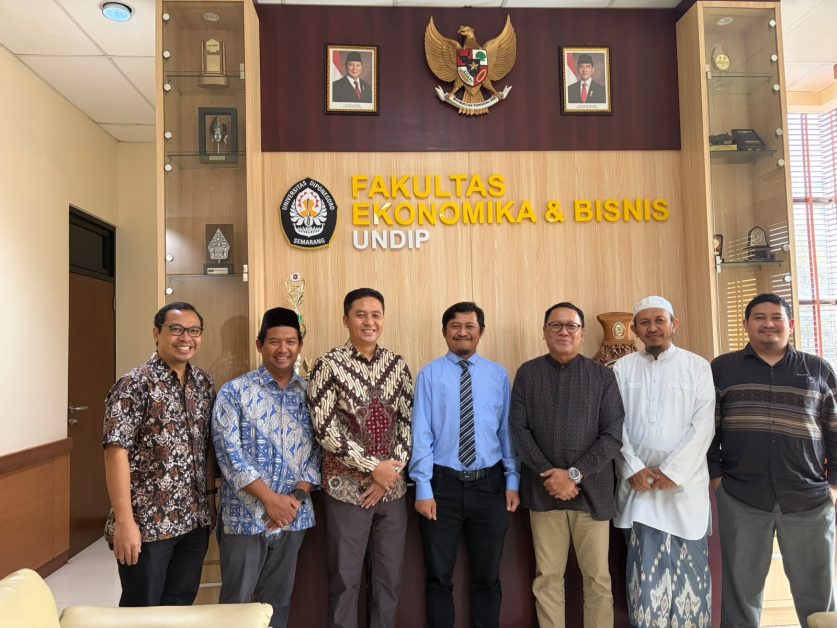
Semarang, June 12, 2026 – The Islamic Economics Study Program, Faculty of Economics and Business, Universitas Diponegoro (FEB UNDIP), organized an International Visiting Lecture entitled “Research Methodology in Islamic Economics and Finance: Designing High-Quality Undergraduate and Master’s Theses” on Friday, June 12, 2026. The event served as an academic platform for students and lecturers to deepen their understanding of research methodologies in the field of Islamic economics and finance. The lecture, held from 08:30 to 11:00 a.m. (WIB), featured Dr. Aam Slamet Rusydiana as the keynote speaker. Currently affiliated with Sakarya University, Türkiye, Dr. Aam shared valuable insights and experiences on designing high-quality research for undergraduate and master’s students. The session was moderated by M. Bastomi Fahri Zusak. During his presentation, Dr. Aam elaborated on various research methods commonly applied in Islamic economics and finance studies, particularly those utilizing secondary data. Participants gained a deeper understanding of panel data analysis and time-series analysis as effective approaches for examining Islamic economic phenomena empirically. These methods enable researchers to maximize the use of available data in producing valid, systematic, and academically significant research outcomes. In addition to secondary-data-based approaches, the speaker introduced several primary-data research methods, including Analytical Network Process (ANP) and Partial Least Squares Structural Equation Modeling (PLS-SEM). These methodologies are widely employed to identify relationships among variables and formulate solutions to various challenges encountered in Islamic economics and finance practices. Furthermore, participants were introduced to the concept of mixed-method research, which combines primary and secondary data within a single research design. According to Dr. Aam, this approach allows researchers to generate more comprehensive findings by integrating the strengths of different research methodologies, thereby providing deeper and more robust analyses of complex issues. Through this International Visiting Lecture, the Islamic Economics Study Program of FEB UNDIP aims to encourage the development of more innovative, high-quality, and impactful research in the field of Islamic economics and finance. The event also reflects FEB UNDIP’s commitment to internationalization by strengthening global academic collaboration and enhancing scholarly contributions to the advancement of Islamic economics and finance at both national and international levels.